BORN IN TATARSTAN: 2 CHICKS OF THE RED BOOK SAKER FALCON WERE BORN AS PART OF A PROJECT TO REVIVE THIS POPULATION
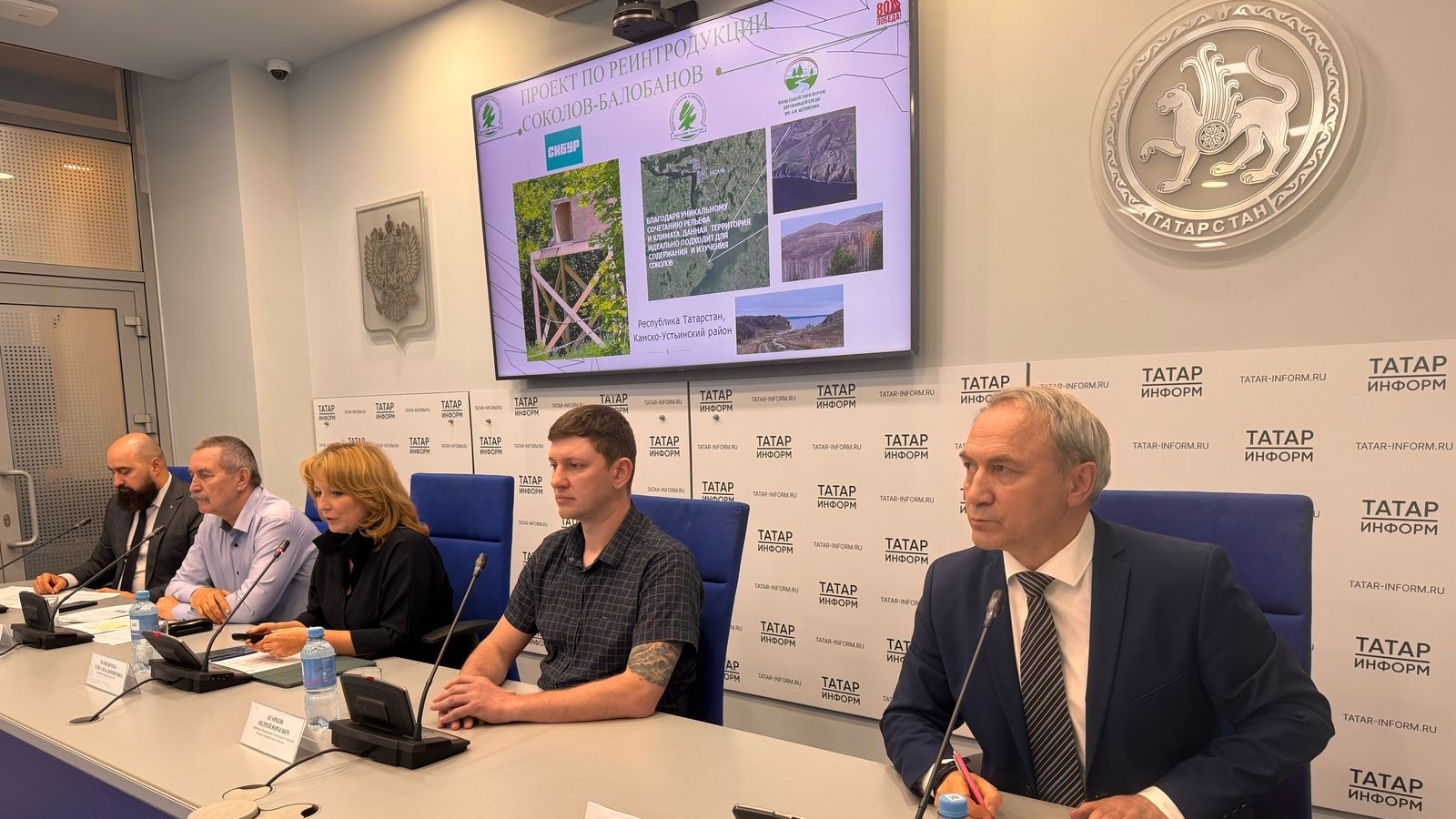
A press conference dedicated to the project of reintroduction of the Saker falcon in the republic was held today at the Tatar-inform news agency.
The speakers of the conference were Olga Manidicheva, Deputy Minister of Ecology of the Republic of Tatarstan, Andrey Agarkov, Deputy Chairman of the Tatarstan branch of the Russian Geographical Society, Alexander Malev, Deputy Director of the Zoo Department of the Kazan Zoo Botanical Garden, and Alexander Zhalyuk, Head of Ecology at Kazanorgsintez PJSC.
The project to revive the Volga-Kama Saker falcon population was initiated by the Ministry of Ecology and Natural Resources of Tatarstan in 2023. The project was curated by the A. I. Shchepovskykh Regional Public Foundation for Environmental Protection. Olga Manidicheva spoke about the plans for this year and the first results.
"The uniqueness of the project this year is that after almost 50 years, two chicks have appeared on the territory of the Republic of Tatarstan. They were born in the Kazan Zoo from birds imported last year. This year, we can already announce that we are releasing our compatriots, our countrymen – two chicks from the Republic of Tatarstan – to continue this unique Volga-Kama Saker falcon population," said Olga Manidicheva, Deputy Minister of Ecology of the Republic of Tatarstan. She stressed that the scientific programs developed within the framework of the project will become part of the national project "Environmental well-being".
During the two years of the project's implementation, 16 birds were released into the natural habitat in the Kamsko-Ustinsky district of the republic: ten falcons in 2023 and six in 2024. In addition, four adult birds were placed in the aviaries of the Kazan Zoo to form pairs and breed offspring. Alexander Malev, Deputy Director of the Zoo Department at the Kazan Zoo Botanical Garden, shared that the process of breeding chicks is very difficult: "We believe this is a great success: for the first time in the history of the Kazan Zoo Nursery, we received Saker falcon chicks."
The release of birds into their natural habitat is carried out with the support and direct participation of the Tatarstan branch of the Russian Geographical Society. Andrey Agarkov, Deputy Chairman of the Tatarstan branch of the organization, noted that taking care of the chicks before their release is an important step that will allow falcons to survive in the wild. "This year we are acquiring 6 chicks in the Moscow region. They, along with two of our chicks born at the zoo, will be taken to Kamsko-Ustinsky at the end of May for placement in hakes, and later until they are released into the wild. This will happen at the end of May," Andrei Agarkov told reporters. He also noted that in the following years, the release of birds is planned at the historical nesting site of the Saker falcon - on the territory of the Saralinsky section of the Volga-Kama Reserve.
Grant support for the project is provided by SIBUR. Alexander Zhalyuk spoke about the company's environmental orientation: "The Sustainable Development Agenda is an integral part of all SIBUR business processes. Since 2019, it has been formalized into a public ESG strategy, a flexible and lively document that is updated on an ongoing basis and acquires new meanings and ambitions. Projects in the field of conservation of ecosystems of species diversity make it possible to unite all stakeholders and contribute to the national priorities of our country. We have been supporting the Saker Falcon restoration project for the 3rd year together with the authorities of the republic, scientists and the public. The joint work allows us to revive these beautiful Red Book birds on the territory of Tatarstan."
The project will be continued in 2025, and as the speakers noted, this year there is a high probability that birds released into the wild in 2023 will begin to return to Tatarstan.