Chicks of Red Book Saker falcons went on their first flight in Tatarstan
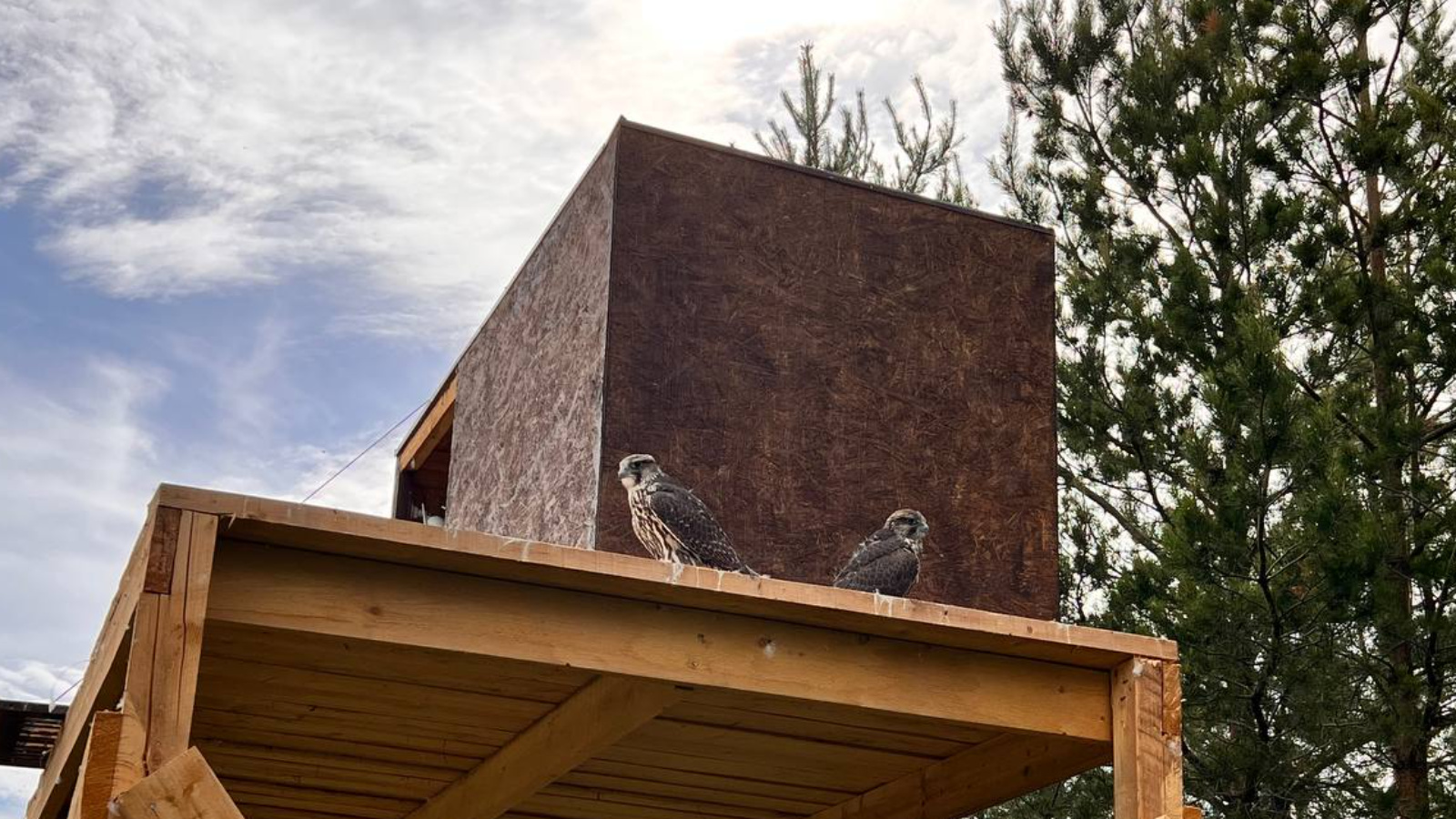
The first center for the reintroduction of red Book birds has been established in the Kamsko-Ustinsky district of the Republic. At the beginning of June, chicks of Saker falcons were brought here from the Moscow region. All movements are controlled by ornithologists and employees of the Ministry of Ecology. 10 falcons, who have now been placed in hacks (artificial nests for chicks) for a month and a half, a camp for volunteers has been organized here in the Kamsko-Ustinsky district.
According to the employees of the Ministry of Ecology, the chicks carried the road well, they were placed in hacks, which are installed at a height of about one and a half meters above ground level, and also "ringed" – rings with numbers were put on their paws to track nesting sites, movement routes and, in general, learn more about the lifestyle of red-book individuals.
The main task of the volunteers is to provide feeding of the chicks, keep a log of observations, and monitor their adaptation. The volunteers were students of the Institute of Fundamental Medicine and Biology of KFU. Every day they are on duty and feed the chicks several times a day. They feed the birds with live food – chickens, through a special window in the hake, so that the sakers do not see a person. So the chicks will learn to hunt and get used to the environment.
"We have 2 hacks with 5 birds in each of them installed here. In the first hake, which looks directly at the Volga, the birds are already flying out. Volunteers are watching the territory, it is fenced, in addition, a sign will be installed with a description of what is happening and why it is undesirable for guests to approach the hacks. Our task is to raise birds in the wild as much as possible without the help of people, so that they can safely hunt in the future and be able to fly to their nesting place," says Andrey Agarkov, Executive director of the A. I. Shchepovskikh Regional Public Fund for Environmental Protection, Deputy Chairman of the Regional branch of the Russian Geographical Society in the Republic of Tatarstan.
The new project is being implemented with the support of the Center for the Rehabilitation of Birds of Prey "Holzan", which is the largest Center in Russia for the maintenance, rehabilitation and breeding of birds of prey.
"The Saker falcon is a very hard-bred species in captivity and very hard to track. Let me remind you that this is one of the fastest creatures on earth. It is extremely difficult to track it. In this case, the Ministry of Ecology of Tatarstan and the A. I. Shchepovskikh Foundation, who are closely engaged in its implementation, should be thanked for this project. Today we have good news, 3 chicks have already flown in our first hake, we were a little worried. The first gathering is always a question, it's always a problem for the bird. However, two have returned, respectively, we can calm down, so the third has a certain skill that will lead her sooner or later to hake," ornithologist Yuri Pavlov, an expert at the Holzan Center, told reporters today. He also noted that the Saker falcon is a unique species that once lived in Tatarstan, but disappeared more than 50 years ago. "It is difficult to assess why the saker is so rare in the current environment. Unfortunately, there are species that, paradoxically, do not want to survive in the modern environment. You can be three times the most resilient, but the paradox is that you don't find yourself in the modern world and that's the mystery. We really believe that this bird deserves to live here, it is an ornament of our Tatarstan sky thanks to this project."
Let us recall that since January 2023, the Ministry of Ecology of the Republic of Tatarstan, with the support of SIBUR, has started implementing this large-scale project, which became the winner of the Sibur PJSC grant competition "Formulas of Good Deeds".
"The idea of a project to revive the saker falcon has been worked out since last year. The Ministry of Ecology of Tatarstan received a proposal to implement a new project in our Republic, especially since there is already a positive practice in the Urals.
We studied this experience and decided to support this project, because in the late 1970s sakers lived in Tatarstan, and now it is a red book bird. We really hope that the chicks that are growing up here will stay here in Tatarstan, and the population will be reborn," said Olga Manidicheva, Deputy Minister of Ecology.
Let us recall that the Saker falcon is a rare bird species that is listed in the Red Books of the International Union for Conservation of Nature, the Russian Federation and the Republic of Tatarstan. The last time the nesting of the Saker falcon in our republic was recorded in 1974 on the territory of the Saralinsky section of the Volga-Kama State Natural Biosphere Reserve.
The Government of the Russian Federation is taking measures to restore the populations of the saker falcon, a striking example is the creation of a center for the reintroduction and conservation of birds of the falcon families in the Kamchatka Territory. The Governments of Tatarstan, Altai, as well as Arab countries where falconry is popular are also interested in restoring the falcon population.
The revival of falconry traditions in the Republic of Tatarstan will contribute to the development of multilateral cooperation with the countries of the Islamic world, where falconry is popular.
The Expert Council under the Ministry of Culture of the Republic of Tatarstan in March 2022 supported the inclusion of falconry in the Catalog of Intangible Cultural Heritage of the Republic of Tatarstan.
The implementation of this project will allow:
- increase the population of rare species of falcons;
- to give prerequisites for the revival of the Volga-Kama population of the saker falcon;
- to replicate the experience in other territories of the Volga-Kama region;
- to promote the attraction of investors, including from the Arab world, for the implementation of larger-scale projects for the breeding of rare bird species.