The creation of a carbon landfill in the Republic of Tatarstan was discussed today at the Ministry of Ecology and Natural Resources of the Republic of Tatarstan
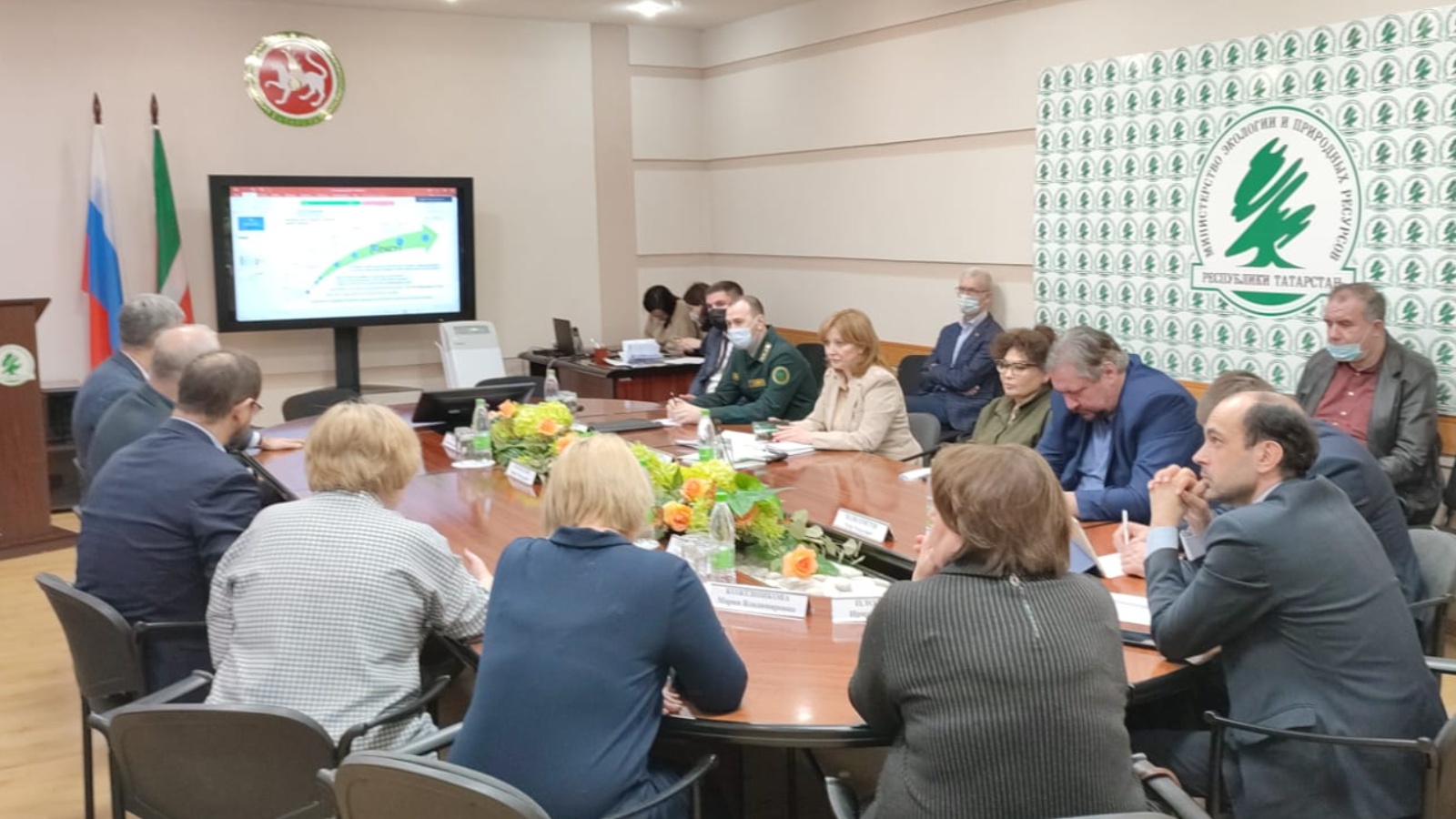
The Ministry held a regular meeting of the interdepartmental working group on climate policy and decarbonization of the Republic of Tatarstan. It was attended by Deputy Minister of Ecology and Natural Resources Olga Manidicheva, scientists, representatives of enterprises and organizations of the republic, ministries and departments. Let us recall that the Ministry of Ecology is the coordinator of decarbonization of the Republic of Tatarstan. A major role in the development and implementation of measures to reduce the carbon footprint is undoubtedly assigned to the joint work of science and industrial partners. It is under the auspices of the Ministry of Science and Higher Education of the Russian Federation that carbon landfills are being created in the country. In Tatarstan, where the scientific approach is decisive in all industries and spheres, the Kazan Federal University has become the base center, the operator of the landfill. The project manager is the Vice-rector for Oil and Gas Technologies, Environmental Management and Earth Sciences Danis Nurgaliev, the responsible executive is the Deputy Director for Scientific Activities of the Institute of Ecology and Nature Management Maria Kozhevnikova. The main role in the development of new nature-like carbon sequestration technologies, technologies for monitoring climatically hazardous gases, educational and formative activities is assigned to the Institute of Ecology and Nature Management, whose director is Svetlana Selivanovskaya.
The need to create carbon polygons is caused by climate change, which experts directly associate with greenhouse gas emissions. They can be reduced with the help of the absorbing capacity of ecosystems - this is what special research is needed for.
In territories with unique ecosystems, the processes of release and absorption of climatically active gases are studied. The goal is to develop a reliable system for monitoring and controlling their emissions. The project involves not only leading universities and scientific organizations, but also eco-oriented industrial enterprises.
For reference:
The carbon landfill is a platform for the development and implementation of new technologies for controlling greenhouse gas emissions. These are territories that combine unique absorbing ecosystems (forests, swamps, farmland) and digital technologies for remote and ground control of greenhouse gas emissions. For example, forests are the main natural sink of greenhouse gases in terrestrial ecosystems in the world: 1 ha of forests can absorb up to 7 tons of carbon dioxide per year. After selecting such natural sites, the project operator installs weather stations and various modern devices for analyzing the concentration of greenhouse gases in the atmosphere, water, and soil. Remote technologies are also used, namely high-precision satellite images, allowing to supplement and verify ground measurements.