Three Russian institutes joined forces to save the snow leopard
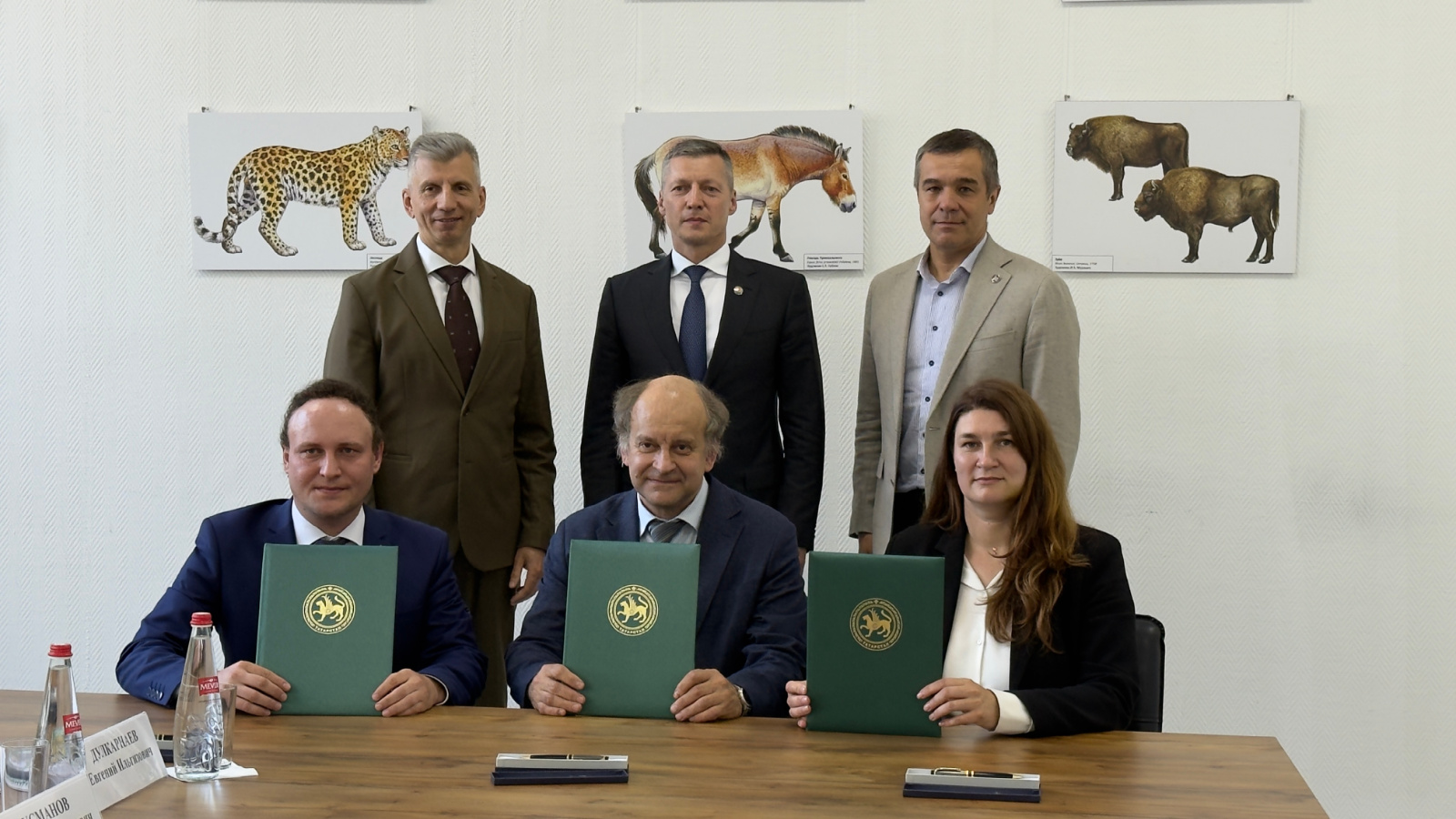
A trilateral cooperation agreement has been signed in Moscow.
An agreement on cooperation in the field of study, conservation and restoration of the snow leopard has been signed in Moscow. The document unites the Severtsov Institute of Ecology and Evolution of the Russian Academy of Sciences, Kazan Federal University and the Snow Leopard Research Center for the Conservation of Biological Diversity.
The signing ceremony was attended by the founders of the center, Minister of Ecology and Natural Resources of the Republic of Tatarstan Azat Ziganshin and Executive Director of UPC Tatneft — Ak Bars LLC Mansur Usmanov.
The agreement lays the foundation for the development of a comprehensive scientific program to restore the population of the snow leopard, a species listed in the Red Book of the Russian Federation.
The three organizations will carry out joint work on the genetic and physiological monitoring of snow leopard populations, create a cryopreservation of genetic materials, and develop scientifically sound methods for preparing animals for release into nature. It is planned to implement international projects with Mongolia, Kyrgyzstan, Kazakhstan and other countries of the species' habitat, as well as joint conferences, seminars and educational programs.
This agreement is another result of many years of efforts to coordinate scientific work on the conservation of the rarest predator. There are less than 90 snow leopard species left in Russia, of which more than half live in the mountains of the Altai Republic.
STATEMENT
The basis for the Moscow agreement was the initiative of the Head of the Republic of Tatarstan, Rustam Minnikhanov. In 2022, a Scientific Center for the Conservation of Biological Diversity was established. Construction was completed in 2024 in the Maiminsky district of the Altai Republic. Since the beginning of 2025, there have been two male and one female snow leopards in the center. The complex includes a research building with a laboratory, a veterinary unit, an economic unit, an aviary complex and residential buildings for employees. The project is being implemented with the support of Tatneft and the scientific support of IPEE RAS.
The international conference in Kazan (March 13-15, 2025) brought together 180 experts from 12 countries of the leopard's habitat — Afghanistan, Bhutan, China, India, Kazakhstan, Kyrgyzstan, Mongolia, Nepal, Pakistan, Russia, Tajikistan and Uzbekistan. At the conference, the participants adopted the Kazan Resolution on the conservation of the species and signed two agreements on scientific and technical cooperation.
The conservation of the snow leopard is included in the national project "Ecological Well-being" of the Russian Federation.