The first Eco-Council of the EAEU countries was held in Moscow. The Minister of Ecology of Tatarstan Alexander Shadrikov took part in it
On December 16-17, the Founding Conference of the International Scientific and Public Environmental Council of the Countries of the Eurasian Economic Union (EAEU) was held in Moscow. The event brought together experts from various fields, including those working in the field of environmental protection – these are the heads of national Academies of Sciences, government agencies, business and expert communities of the Union countries.
The common goal is to find joint solutions to urgent problems, to understand how to develop the economy, reducing the impact on the environment, including within the framework of achieving the goals of the new national project "Environmental well-being".
During the meeting of the Supreme Eurasian Economic Council, Russian President Vladimir Putin stressed that the environmental and climate agenda is becoming an important area of interaction between the EAEU countries. According to him, it is cooperation in these areas that opens up new prospects for jointly solving common problems related to climate change and environmental protection.
The creation of the International Scientific and Public Environmental Council of the EAEU has become an important step towards the formation of an independent expert platform that will combine knowledge and practices to solve key tasks in the field of ecology, environmental management and sustainable development.
"The round tables within the framework of this event are related to issues that concern not only Russia today, but also all the EAEU countries. These are issues of waste management and conservation of water resources, and environmental education," said Stepan Kalmykov, Vice President of the Russian Academy of Sciences.
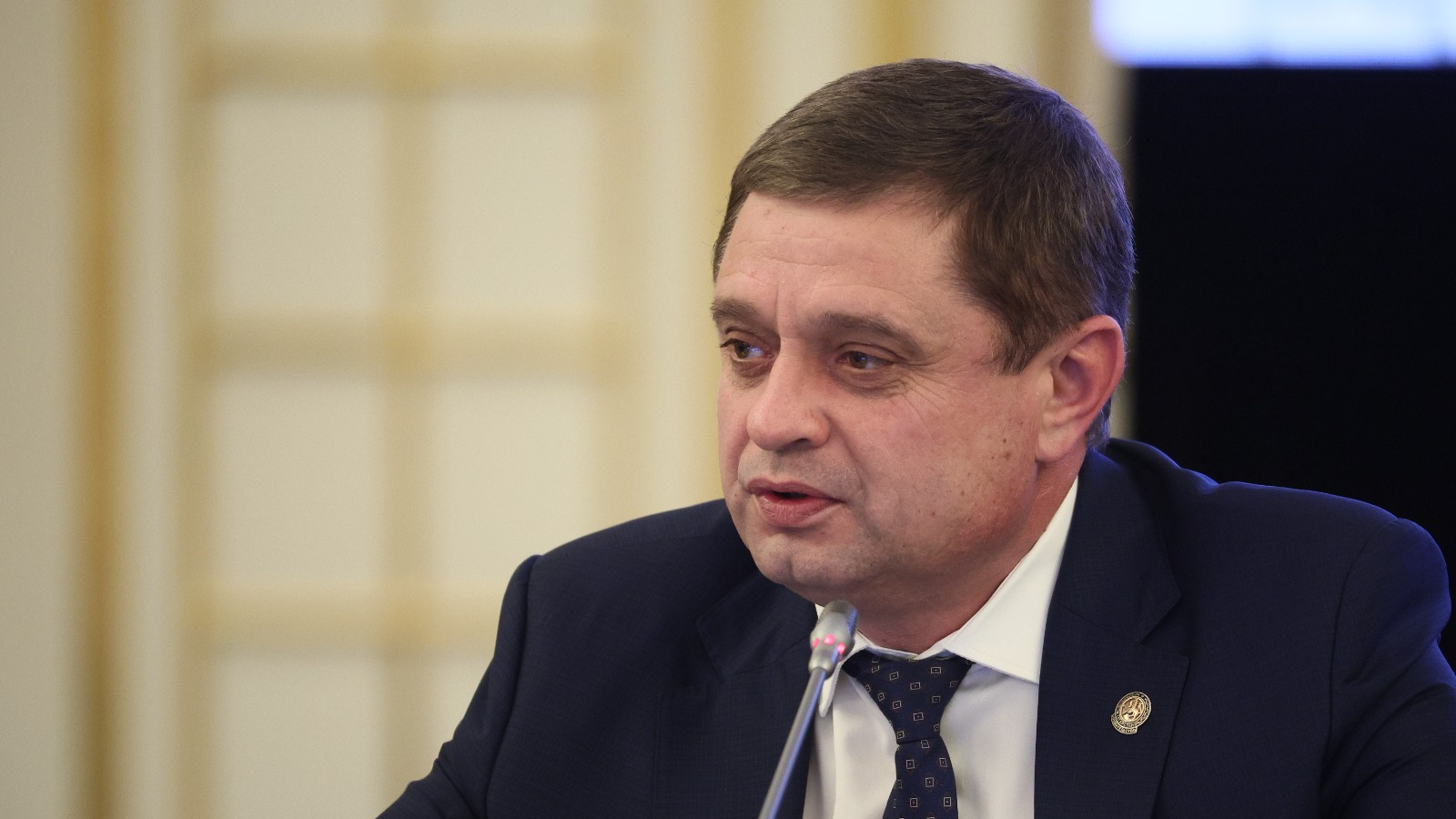
Within the framework of the round table "Current forms of coordination and interaction of scientific, public, and business circles in maintaining environmental safety", Tatarstan Minister of Ecology Alexander Shadrikov made a report.
He noted that effective counteraction to environmental challenges is possible only through the combined efforts of science, government, society and business.
"Tatarstan is a dynamically growing region with an annual increase in industrial production. Since 1998, the volume of GRP in the republic has increased 3 times, while the level of negative impact on the environment has decreased. The amount of emissions into the atmospheric air decreased by 24.1%, the number of discharges into water bodies by 67.2%. It is not easy to maintain such a dynamic balance and is possible only in a close constructive dialogue between the state, business, science and society."
As an example, the speaker cited industrial enterprises of the Republic, which, within the framework of concluded Agreements, transmit data from their automatic monitoring posts for atmospheric air quality to the Ministry of Ecology.
8 such posts have been installed in Nizhnekamsk district (PJSC Nizhnekamskneftekhim - 5 units, JSC TAIF-NK - 2 units, JSC TANECO - 1 unit), 3 posts have been installed by PJSC Tatneft in Almetyevsk, 1 post of PJSC Kazanorgsintez in Kazan.
"This is an example of openness and environmental responsibility of our large petrochemical companies," Alexander Shadrikov stressed in his speech.
He also spoke about decarbonization projects in his report. A working group on climate policy and decarbonization plans has been established in the republic, which includes representatives of industrial enterprises, the Academy of Sciences, universities and ministries. The Action Plan for the implementation of the Strategy of Socio-economic Development with Low Greenhouse Gas Emissions of Tatarstan has been adopted, which includes 57 events and 28 implementing organizations. The plan is designed to achieve carbon neutrality of the republic by 2050. Over 10 years, the net greenhouse gas balance has already decreased by 27.7% and amounts to 23 million tons of CO2 equivalent